

The State of Illinois Framework Project Management Office is engaging
service recipients, community service providers and advocates
so that Illinois' redesigned information and service delivery system will work well
for them and the seven state agencies that make up the Framework.
service recipients, community service providers and advocates
so that Illinois' redesigned information and service delivery system will work well
for them and the seven state agencies that make up the Framework.
The Illinois Framework Listening Tour is complete, for now.
From June through November, the Illinois Framework Stakeholder Engagement Project held 25 Listening Tour events across Illinois, including eleven Town Hall Conversations, eleven Focus Groups with service recipients, and three virtual conversations. These meetings generated interest and goodwill for the Illinois Framework, as well as over 7,000 individual comments and feedback on the Framework design. More activities and events will be scheduled in the future. For now, the SEP team is analyzing the data and preparing its final report, which is due in January 2012. Please sign up for updates and notifications on future activities.
Facilitated by the Illinois Public Health Institute.
Emerging Themes: community providers and service recipients are encouraged by the possibilities in the Framework to improve the healthcare and human services system in Illinois, and are energized by the State’s commitment to leading these changes and engaging customers, community providers and advocates.
Register here to receive periodic updates on Framework activities.
Welcome to the Illinois Framework Stakeholder Engagement Project
The State of Illinois is planning a new and integrated health and human services system organized around the capabilities and needs of Illinois residents: the Illinois Framework.
The overall goals of the Framework are to improve customer attainment of economic self-sufficiency and independence as an outcome of service provision, as well as, create administrative efficiencies.
The key to making the Framework work for the people who receive and provide services is to include their ideas and insights into building it, beginning with the planning and design phases of the project. To make sure you are involved in this process, the Framework Stakeholder Engagement Project is holding meetings with residents, service providers and advocates across the state. These meetings will introduce you to the Framework and be focused on hearing your ideas and concerns.
We held eleven sets of meetings between June through October, and the results of the meetings will be analyzed and included in the state's design for the new system. This web site is your home for information about these meetings and the place for community providers and client advocates to register to participate. Separate meetings are being planned specifically for service recipients; please contact us for more information.
An overview of the Illinois Framework (more information is available at the State of Illinois Framework Home)
The Framework Project is a collaboration among the state agencies charged with the delivery of healthcare and human services to more than one-fifth of all Illinois residents yearly. Illinois plans to re-design the present system so it provides residents with easier access to services, simplifies the process and reduces the need for multiple visits to different state offices. Since many of our services are provided by organizations in your communities, we plan to make the process easier when you visit their offices, too. A summary of the Framework Vision is presented here.
Overall, we want to create an integrated, streamlined and efficient healthcare and human services delivery system that provides easier access to high-quality services that the State provides or funds. Integrated services will be built around service recipients and available in any state or community-based office, by phone or mail, or online. The Framework Project will expand access to services, enable data-driven decision making, improve service outcomes, and capture the efficiencies that are possible with current technology.
An Overview of the Framework Stakeholder Engagement Project
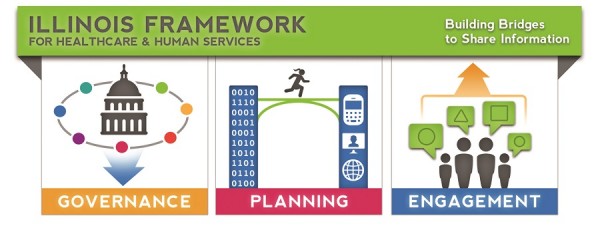
Service recipients and providers and other Framework stakeholders will be informed about the project’s conceptual design, engaged in providing input to improve it, and connected to the project to ensure ongoing collaboration and support. The projects integrated activities will:
Three principle activities
Listening Tour
General Timeline
Start-up and Planning Phase (February– April, 2011)
Implementation Phase (May– October, 2011)
Analysis and Reporting Phase (August, 2011–January, 2012 )
For more information, contact Peter Eckart at the Illinois Public Health Institute.
The Framework Project is a collaboration among the state agencies charged with the delivery of healthcare and human services to more than one-fifth of all Illinois residents yearly. Illinois plans to re-design the present system so it provides residents with easier access to services, simplifies the process and reduces the need for multiple visits to different state offices. Since many of our services are provided by organizations in your communities, we plan to make the process easier when you visit their offices, too. A summary of the Framework Vision is presented here.
Overall, we want to create an integrated, streamlined and efficient healthcare and human services delivery system that provides easier access to high-quality services that the State provides or funds. Integrated services will be built around service recipients and available in any state or community-based office, by phone or mail, or online. The Framework Project will expand access to services, enable data-driven decision making, improve service outcomes, and capture the efficiencies that are possible with current technology.
An Overview of the Framework Stakeholder Engagement Project
Service recipients and providers and other Framework stakeholders will be informed about the project’s conceptual design, engaged in providing input to improve it, and connected to the project to ensure ongoing collaboration and support. The projects integrated activities will:
- Support user-centered design
- Identify and document current system weaknesses and strengths
- Synthesize perspectives across state agencies, service providers, service recipients, and external advocates
- Enhance stakeholder ownership in and commitment to the long-term sustainability of the Framework
Three principle activities
Listening Tour
- Service recipients, provider leaders & line staff, advocacy & interest groups
- Town hall meetings, focus groups and other activities with processes that support hearing all voices
- Promotion of listening tour components to ensure participation, and information to stakeholders on Framework Project plans and progress
General Timeline
Start-up and Planning Phase (February– April, 2011)
- Finalize work plan and approach, hire staff and consultants,
- Develop the outreach and engagement database,
- Work with key informants to develop messaging and communications methods (e.g. web, e-bulletins, webinars, etc.),
- Design town hall meeting and focus group process and strategy,
- Identify key documents for review and synthesis, and
- Schedule and secure sites for the town hall listening tour events.
Implementation Phase (May– October, 2011)
- Launch web-site and other e-communications and feedback mechanisms. Conduct town hall meetings, virtual town hall meetings, key informant interviews and focus groups.
- Organize participation in the information gathering process and disseminate the high-level conceptual design document.
- Support development of the Framework Project Advisory Committee.
Analysis and Reporting Phase (August, 2011–January, 2012 )
- Analyze and synthesize data collected in the implementation phase.
- Support initial Framework Project Advisory Committee meeting.
- Produce report on provider, client and other stakeholder input and perspectives.
- Plan for opportunities to continue and extend stakeholder engagement.
For more information, contact Peter Eckart at the Illinois Public Health Institute.